Defining Color Personalities with Grayscale and Quilting Color Wheel
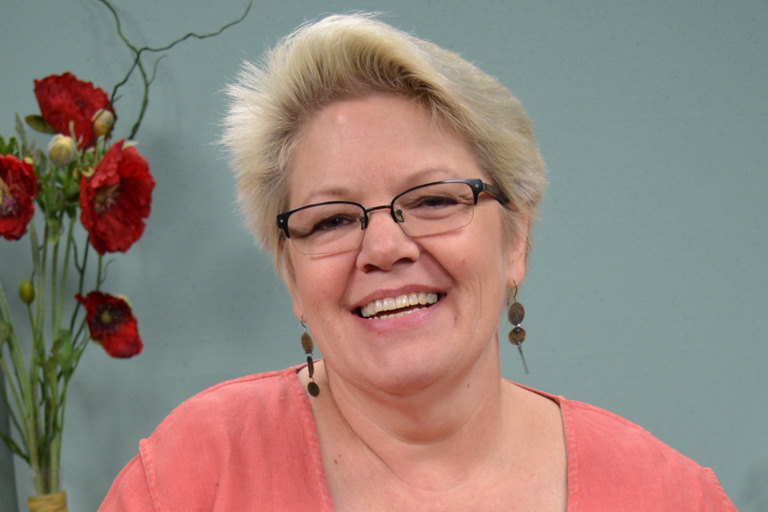
Heather ThomasHeather Thomas displays the quilting color wheel and gray scales of each color that she painted. She put the pure hue on the outside, added black to yield shades in the middle, and grey in the middle to make tones. You can learn to do the same and understand color better with these step by step instructions.
For more helpful tips on quilt colors, check out this video on How to Choose Quilt Colors today!
I've been teaching myself and others about color for about 15 years now, and in no part of that journey have I learned more than when I decided to paint the color wheel and then paint out gray scales of each color. Doing that has helped me to really understand how color changes when you put white, black, or gray in it, and that is the color scale. And the color scale is where we get all of the varieties of color. Here we have the color wheel painted out using just inexpensive craft paint. And we have pure hue on the outside, and to the pure hue I added black to yield the shades, and then I added gray to yield the tones and white to yield the tints.
It's so interesting to find out how that color changes right before your eyes. And you know that when you're mixing it, that it's actually true. A lot of us have a hard time understanding that olive is yellow, and that's what happens when you add just a little bit of black to yellow. So consider getting yourself some paints and painting color, so that you can get to know it better. Each color has really definite personalities, and here, I've selected a grouping of each color, including the pure hues, tints, tones and shades.
I wanna tell you a little bit about them. It's kind of like introducing old friends. Here with yellow, we're gonna start with tints, which are the lighter, white added, going into the pure, and then, as we add gray and black, we turn into olivey. Pure yellow is very happy, it's the happiest of all colors. But if you're around it too much, like if it's painted in a room that you spend a lot of time with, it can get you very agitated because it's got so much energy.
Yellow green has that power and energy of yellow, but it's softened by green. Green is a very cool, easygoing color. So here the yellow green has intensity in the pure hue and the lighter versions, and then it gets kind of much more interesting and mature looking when it has the tones and the shades with the gray and the black added. Yellow orange has that yellow also, and yellow orange is also a very happy color. A lot of fast food restaurants and point of sale things will have yellow or yellow orange in them because they make you happy, but they also make you kind of flippant with your money, makes you happy to spend it.
So here we have lighter yellow oranges and the darker richer yellow oranges. When the browns or the black is added, we get browns, and those are, make us think of autumn and deepening. Orange is the same way. Orange is a happy color too, but it has a little bit more finesse to it because it has some of red, and red is very energetic and powerful, whereas yellow is not so powerful in the same way, it can just be overwhelming. The orange is a little less powerful than the yellow, here in its lighter versions.
Here in the pure hue, and we always think of Halloween when we see orange and the pure hues, and then with the black added, we get to that deep rich chocolatey brown. Red orange has the power of orange, which again includes some of that yellow. And then it has the somewhat, I guess you would say calming influence of red, even though red isn't a very calm color, but it takes away some of that exuberance of the yellow. And red orange, probably my favorite color to work with right now, makes us think of blood, which is the life force, and it's a very powerful color. Also autumn, again, deep, deep forests with beautiful colored leaves.
Here you can just see all the leaves that happen in autumn. Red is a very powerful color, and it has high energy. It's not as happy as yellow, but it's very, very powerful. It makes us think of love because of Valentine's day, but it also makes us think of rage. And when you say you're seeing red, it's because you're angry.
Here we have the lighter reds, which are more melony than they are pink, and then the deep, dark, rich blackened reds, which move into the color we call burgundy. Red violet is a sweet color. We bring in the timidity of violet with the power of red. Here we see it in its lighter versions, and in its pure hue it's somewhat bubblegummy. In the darker versions with black added, it goes more towards those wine colors.
Violet can be very, very weak if not used properly. It's hard to find it in it's pure hue. It's always been the color of royalty because it's a difficult dye to find, and it's very expensive. When we add black to it, it almost goes away because it is the closest color to black. So we have to be careful of it in its shades because it will just kind of evaporate.
It's very pretty and soft in it's lighter, pure tints. When we add blue to the violet, we get a really beautiful color. Sometimes we call light blue violet, periwinkle. We're used to seeing it a lot in it's lighter values, in it's tints and it's pure hues, but we don't often see it in it's dark, sultry tones and shades. It's a great color for night sky.
The blues, again, as we move closer to black, those colors, because it's a dark inherent value, the color kind of goes away, and it's not very strong or powerful. When we have it in the pure hue, it's very happy. It makes us think of nature, of deep waters, it's very calming. In the light versions, it makes us think of the sky. Blue green is the most calming of all the colors.
It has the calming effect of blue without what sometimes can be depressing. The blue tones can be somewhat sad. The blue green has the green, which is life force added to it. Here in the lighter versions it's soft and delicate. It's a great color to paint a child's room.
In the darker versions, it becomes a little bit more adult, a little bit more mature looking and much more rich. The green makes us think of again, like I said, the life force, forest, grass, everything that's growing is surrounded by green. The light colors are happy. The midtones are really easy to work with, and the dark dark shades and tones are really luscious. So getting to understand the personalities of color will help you determine how those colors are gonna work with each other when you're using them together in groups.
Because knowing the colors is enough, knowing how those colors are gonna interact with each other is what you're really after. Like I said earlier, learning to paint the gray scales really helped me to understand all the variances of colors that are out there, and now I think I've got a little bit better of a grasp. This is a true gray scale, meaning that it goes from black to white, and it has several versions of gray in between. Now we can paint out the color scales in the same way. So what I did is, I bought some really inexpensive acrylic craft paint, and I bought it in six colors, the primaries of red, yellow, and blue and the secondaries of violet, green, and orange.
It's important to look at the labeling on your paint because not all reds are made equal. You wanna know what that red is. My package here says that it's naphthol red deep. That means that it probably has a little black in it already, but finding just the pure hues is really difficult to do. I also had to buy a very large tube of white and a large tube of black, so that I could make gray.
This is the gray scale of yellow, or the color scale. And with this, I started with the pure hue here, and then this row has tints, which is the pure hue with white added. This is tones, the pure hue with gray added, and then this is shades, the pure hue with black added. If I hadn't painted this out myself, I wouldn't have believed that some of these colors were yellow, and I've been studying color for a really long time. So I think that this is a really great way for the average person, who's wanting to learn more about color, to really set into motion that knowledge of color.
So I want you to look at these gray scales, and then I'll show you how to go about painting them out. So this one is the yellow and notice how it moves to olive in its darkest shades. This is yellow orange, and notice how dirty we come here, and how this goes to greeny olives again. This one is orange, and notice how, when you add lots of black, we start to yield brown. This is red orange, and the browns now, as the shades get darker, become a little bit richer because of the red.
Here we have red, and notice how, here in the light versions of red, these are a melony pink rather than the true bubble gummy pink. And the reds here, when the shades are made and the black is added, become very, very rich and exotic looking. Here is where we get the actual pink, or the bubblegum pink or Carnation pink, if you think back to your first box of crayons. And when we add white to the red violet, we get that yummy pink. We also get some really deep grape tones or burgundy tones.
The violets here, notice what happens when we start adding black to the violet, we instantly start to weaken it. And it just begins to the point where it's hard to even determine that it's violet anymore, it just looks black. The same can happen with the blue violet because it has the violet in it too. So over here, it's quite weak, but here it's just really beautiful. You add white to, it and it kind of brightens it up a bit.
And here's the blue, blue green, the green, and the yellow green. So what I have done as I've made these is, I took a container that had multiple little areas in it that I could put paint. This was really helpful because before I wanted to start painting anything, I wanted to make sure that I could yield six very different tones. And if I were to just add a little white and paint this and add a little bit more white and paint that, it might get to the point where I've added so much white that I can't see the color anymore, and I'm one or two short. So I mixed all six colors before I started painting.
I also mixed all of the gray I would need to paint all of my colors with because you want to have what's called a medium-valued gray. If you buy a packaged gray, it would be called Payne's Grey. But here we have the black and the white and the medium-valued gray, and this is the type of gray that I used for all of my tones. The black is what makes the shades, and the white is what makes the tints. So I simply, on a piece of paper, heavy gauge paper that can handle getting wet with paint, drew myself a grid, and now I'm ready to paint.
So I'm gonna start with red, and I'm gonna put it in the center here, so that I have a little bit of paint to add more to if I need to. And I'm gonna try to drop the same amount of paint in each one of these little tubs. And you're gonna have to get used to the idea that you're gonna be wasting some paint, but it's a very valuable lesson, so it's not that big of a deal. There we go. Now we're gonna be adding white to these, and the very first one, we're gonna add very little white.
So a tiny little bit to just slightly lighten that red. And I like to have the red here, so I have the base color, or the pure hue, to compare it against. So this next one, I'll add more white, and I'm trying to yield a variety of red that is lighter than the first one that I just mixed. And so that one is lighter. And to this one, I'll add even more white.
And I can tell right away that's not gonna be enough, so now that is lighter than the last one. So I'll just keep doing this until I get to the point that, for my last piece, my last bit of color, I'll take a little bit of the red and add it to white instead, and that will yield a very, very pale red that I can use as my lightest form of the color. So I just wanna have a nice gradation of color before I start painting. I'll do the same exact technique, using the gray to make the tones and using the black to make the shades. This is a technique that's really really gonna help you understand how colors are formed.
And when you understand how they're formed, then you start to get to know their personalities even better, and then you can predict how they're gonna play with each other on the surface of your quilts and your other artwork, so that every time you make a quilt, you're gonna have a very successful piece when you're done. Try painting, I think it'll really help you with your color knowledge.

Share tips, start a discussion or ask other students a question. If you have a question for an expert, please click here.
Already a member?
No Responses to “Defining Color Personalities with Grayscale and Quilting Color Wheel”